

CAUCE 2024 National Hybrid Conference
At the 2024 conference, attendees will engage with one another, build their professional development, and collaborate to spark ideas for new ways to improve and innovate the field of Continuing and Professional Education in Canada.
We have lots to learn and discuss at #CAUCE2024. We hope to see you in Calgary May 22-24, 2024!
CAUCE 2024 in-person registrations are SOLD OUT!
Virtual registrations are still available!
Theme
Reignite Innovation and Entrepreneurship in Continuing Education
Continuing education units are being challenged in many ways. We are expected to develop programming that suits changing student demographics, to maintain high-quality instruction, to serve a global student body, and to remain financially viable. Consequently, it’s time to reignite our commitment to innovation and entrepreneurship.
The word ‘reigniting’ is a nod to the ‘great reset’. How we work, learn and live is changing quickly in a post-pandemic, digitally enabled world. From instructors and leaders to learners and governments, all interested parties are rethinking the evolving fluidity and intersectionality between work and learning. Successful Continuing Education units will respond and adapt to serve learners and communities by continuously reigniting our innovative spirit.
The entrepreneurial element of this theme is a nod to the University of Calgary’s Ahead of Tomorrow strategy that states “. . . students will thrive in programs made rich by research, hands-on experiences and entrepreneurial thinking.” In other words, similar to entrepreneurs, continuing education practitioners are always looking for new ideas and better ways of doing things. We are passionate, flexible, and resourceful in our mission to deliver high-quality educational opportunities.
At CAUCE 2024 we will learn from one another, and we will reignite our creativity, innovation, and passion for lifelong education. We will exchange innovative ideas in the latest research, programming, online learning, and more. Through engaging speakers, interactive workshops, and communities of practice, we will inspire each other to respond to the needs of adult learners across Canada.
Host
University of Calgary Continuing Education
Hosted by University of Calgary Continuing Education, our 70th annual conference takes place at the UCalgary downtown campus in Calgary, Alberta.
The University of Calgary is situated on land Northwest of where the Bow River meets the Elbow River, a site traditionally known as Moh’kins’tsis to the Blackfoot, Wîchîspa to the Stoney Nakoda, and Guts’ists’i to the Tsuut’ina. On this land and in this place the UCalgary community strives to learn together, walk together, and grow together “in a good way.”
The University of Calgary, located in the heart of Southern Alberta, both acknowledges and pays tribute to the traditional territories of the peoples of Treaty 7, which include the Blackfoot Confederacy (comprised of the Siksika, the Piikani, and the Kainai First Nations), the Tsuut’ina First Nation, and the Stoney Nakoda (including Chiniki, Bearspaw, and Goodstoney First Nations).
UCalgary Continuing Education has as a mission to provide high-quality educational opportunities for lifelong learners, regionally and globally, thereby empowering people and transforming communities for a better future. It offers a wide range of extension seminars, courses and programs to individuals and organizations seeking opportunities for professional development, academic preparation, and personal enrichment.
Join us!
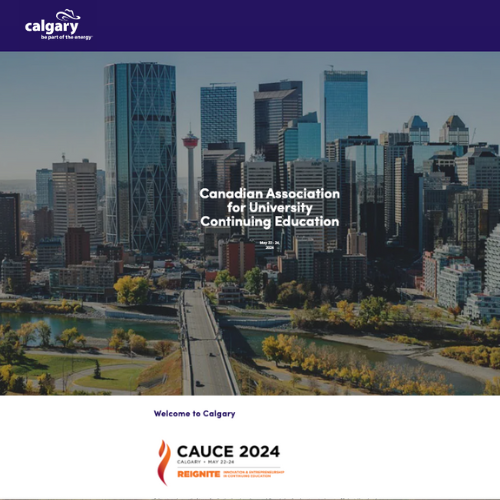
Calgary is located in the province of Alberta and is the fourth largest city in Canada. Home to 1.6 million people, Calgary is Canada's youngest and third-most diverse city.
- Calgary is a city with a proud heritage and a limitless future.
- This is the most livable city in all of North America and one of the most livable cities on the planet.
- Canada’s sunniest major city.
- Innovation capital of Canada. Entrepreneurs built this city, and it continues to be the city of choice for the world's best entrepreneurs.
Make the best of your visit and spend the week in Calgary! Come for the Victoria Day weekend, then attend CAUCE 2024 from May 22-24.
Bring the family, there are so many things to do. We hope to see you there!
Committees
Our 2024 conference is made possible through the hard work and dedication of our members, with special thanks to the staff at University of Calgary Continuing Education. Thank you everyone!
- Jennie Atkins (Chair/Liaison), University of Windsor Continuing Education
- Jen Gordon, The Chang School of Continuing Education, Toronto Metropolitan University
- Sheila LeBlanc, University of Calgary Continuing Education
- Coral Sawchyn, CAUCE Secretariat, University of Saskatchewan
- Ewa Wasniewski, University of Calgary Continuing Education
- Deanna Wolfe, CAUCE Secretariat, University of Saskatchewan
- Karen Woloschuk, Extended Education, University of Manitoba
- TBD
- Raquel Collins, UBC Sauder Continuing Business Studies
- Julia Denholm, Lifelong Learning, Simon Fraser University
- Jennifer Farrell, St. Francis Xavier University, Centre For Online Learning & Professional Studies
- Patsy Knutson, University of Calgary Continuing Education
- Juan Mavo-Navarro, School of Continuing Studies, University of Toronto
- Natasha Rajcevic, University of Calgary Continuing Education
- Dawne Ramashoye, School of Continuing Studies, McGill University
- Coral Sawchyn (Liaison), CAUCE Secretariat, University of Saskatchewan
- Soula Serra, Centre for Executive & Professional Education, University of Windsor
- Ewa Wasniewski (Chair), University of Calgary Continuing Education
- Rachel Bennett, Simon Fraser University
- Lorraine Carter, McMaster University
- Anne Dwyer, McMaster University
- Sylvia Franklin, Toronto Metropolitan University
- Kirsten Hearne, Okanagan College
- Vui Kien Liau, University of Calgary
- Deanna Wolfe (Chair/Liaison), CAUCE Secretariat, University of Saskatchewan
- Stacey Woods, University of Manitoba